How Elon Musk’s Friendship With the FCC Smoothes the Way for SpaceX’s IPO

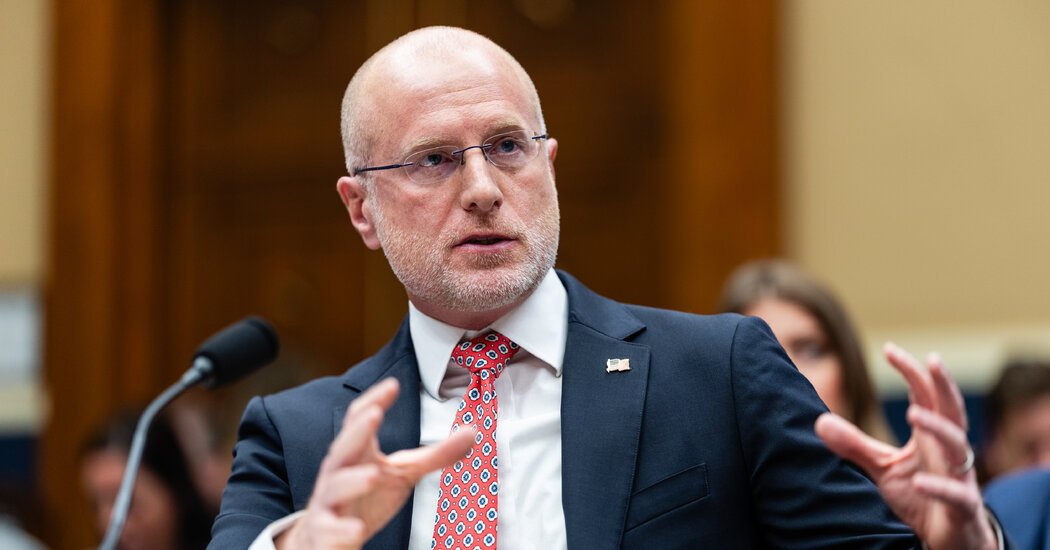
Days after the US presidential election in November 2024, Brendan Carr, a member of the Federal Communications Commission, posted a photo of himself with Elon Musk and President-elect Donald J. Trump at a rocket launch for SpaceX.
“A historic day at Starbase,” Mr. Carr wrote in the post, referring to the Texas headquarters of Mr. Musk’s rocket and satellite company. “Another giant leap forward.”
Around the same time, Mr. Musk recommended Mr. Carr to Mr. Trump as an ideal leader for the agency. Shortly thereafter, Mr. Carr got the job.
Since then, the FCC chairman has lavished praise on Mr. Musk, repeatedly expressing his admiration for the tech mogul. He has greenlighted a satellite request from SpaceX and changed some of the agency’s rules to benefit the company.
“I would be very hesitant betting against Elon Musk,” Mr. Carr, a Republican, told Reuters last month. Those who did, he said, “have lost a lot of money along the way.”
Mr. Carr’s stance on SpaceX and Mr. Musk stands out from his behavior with other companies that the FCC oversees. He started an investigation into the satellite company EchoStar, a SpaceX rival, after Mr. Musk’s company complained about it. He targeted the television networks ABC and NBC over their coverage of Mr. Trump, threatening to take away their broadcast licenses. And he threatened to block media and telecom deals over their diversity, equity and inclusion policies, opening investigations into Disney and Comcast.
Mr. Carr’s “favoritism is unbecoming of a public official tasked with overseeing what’s supposed to be an independent consumer protection agency,” said Jessica J. Gonzalez, a co-chief executive of Free Press, a left-of-center media and tech advocacy group. She added that it was rare for a public official to even appear to “pick winners and losers.”
The relationship between Mr. Musk and Mr. Carr is more important than ever as SpaceX prepares for the world’s largest initial public offering ever this week. As the top regulator of broadcast and communication licenses that are required to transmit signals across publicly owned airwaves, Mr. Carr wields major influence over the expansion of Starlink, SpaceX’s cash cow and only profitable subsidiary. The service’s 9,600 satellites fly in low Earth orbit, beaming internet service to 10 million customers around the globe, including airlines, governments and the Ukrainian Army.
Starlink hauled in more than $11.4 billion in revenue last year, constituting 61 percent of SpaceX’s total sales, according to the company’s filings, and said it could eventually grow to $1.6 trillion in revenue. SpaceX expects to be valued at $1.77 trillion upon going public, which would make it larger than Meta, and it will need Starlink to justify that valuation and continue growing.
The FCC was mentioned 25 times in SpaceX’s offering prospectus — more than any other government agency — including references to its satellite spectrum licenses. The Federal Aviation Administration, which oversees rocket launches, was referred to 23 times.
“Carr has taken multiple actions for which Musk was the prime beneficiary,” said Blair Levin, an advisor to New Street Research, an investment research firm, and a former chief of staff at the FCC. He added that Starlink “has gotten a huge amount from the Trump administration and Carr.”
Mr. Carr has denied favoring SpaceX and has said he supports all companies. In February, he approved Amazon’s request to launch 4,500 satellites for its satellite internet service, Leo, also a SpaceX competitor.
“President Trump is restoring US leadership in next-generation technologies,” an agency spokesperson said in a statement. “And the FCC’s work to boost America’s space economy is part of that effort. We now have multiple different satellite providers competing to provide consumers with affordable, high-speed connectivity.”
Mr. Musk and SpaceX did not respond to requests for comment.
It is unclear when Mr. Carr and Mr. Musk met first. Mr. Carr has long said that he admires Mr. Musk’s free speech stance, and that liberals unfairly targeted the entrepreneur during the Biden administration.
In 2022, a public interest group asked the FCC to block Mr. Musk’s $44 billion acquisition of Twitter, now Carr, one of five commissioners at the agency at the time, issued a statement that said the FCC had no authority to do so.
A year later, the FCC revoked Starlink’s access to the Rural Digital Opportunity Fund, a federal subsidy program that provides internet service to communities with little to no access. Starlink did not meet the speed and other technical requirements for eligibility, Jessica Rosenworcel, a Democrat appointed chair of the agency under the Biden administration, said at the time.
Starlink swiftly lost $885 million in subsidies. Mr. Carr called the move “regulatory harassment” against Mr. Musk.
In 2024, Mr. Carr came to Mr. Musk’s defense again.
The Ukrainian Congress Committee of America, a nonprofit, petitioned the FCC to block Starlink’s satellite licenses over claims of interference in communications during the Ukrainian–Russian war. Mr. Musk had refused Ukraine’s request to activate his Starlink satellite network in Crimea’s port city of Sevastopol to aid an attack on Russia’s fleet, the group claimed.
Mr. Carr slammed the group’s petition, saying it was “part of a clear and repeating pattern of regulatory harassment that accelerated the moment Elon Musk stood up for free speech.” The FCC did not act on the request.
Mr. Musk invited Mr. Carr in August 2024 to SpaceX’s Boca Chica, Texas, facilities, where the men posed for a photo together.
“Elon Musk has transformed long-dormant industries, and he’s developed a first principles ‘production algorithm’ to deliver results,” Mr. Carr posted at the time.
The next month, Mr. Carr posted on The government there had blocked X in Brazil over the spread of hate and misinformation. Starlink’s internet, however, continued to give users access to the social media site.
Mr. Carr threatened that penalizing Starlink would hurt the FCC’s partnership with the Brazilian regulators.
“Much appreciated,” Mr. Musk replied to Mr. Carr’s post. Mr. Musk eventually backed down in Brazil, complying with the government’s demands that X block certain accounts spreading misinformation. His businesses still operate there.
During the presidential transition, Mr. Musk issued his recommendation of Mr. Carr for the FCC job. Mr. Carr later started the investigation into EchoStar after SpaceX complained that its rival was not fully utilizing its spectrum, the valuable radio frequencies used to transmit phone calls and broadband internet.
Mr. Carr’s intervention led EchoStar to sell some spectrum to SpaceX a year later for $17 billion. Starlink could use that spectrum to send its services direct to consumer phones and other devices, allowing it to compete with AT&T and Verizon, telecom analysts said.
EchoStar did not immediately respond to a request for comment.
In January, the FCC granted SpaceX’s request to deploy 7,500 satellites to bolster internet service worldwide over protests from some rivals that the approval could harm competition. That same month, SpaceX asked the FCC for permission to deploy one million satellites to create data centers in space to help power artificial intelligence development, an application that is still underway.
Astronomers and environmentalists have said SpaceX’s application could alter the skies and create a junkyard of space debris. Sleep experts have also warned that floating data centers could light up in a way that would disturb the circadian rhythms of plants and animals.
Amazon hit back, too, calling Starlink’s application “a lofty ambition rather than a real plan” that would take centuries to complete.
But Mr. Carr was having none of it.
“Amazon should focus on the fact that it will fall roughly 1,000 satellites short of meeting its upcoming deployment milestone, rather than spending their time and resources filing petitions against companies that are putting thousands of satellites in orbit,” he posted on X in March.
After lobbying by SpaceX, the FCC in April loosened decades-old rules dictating how satellites could share spectrum. The FCC voted to modernize the rules, which will cut costs for satellite internet companies and allow for faster service.
The agency said the rule-making process benefited “from rarely available, real-world measurement campaigns” by SpaceX and Starlink.
Ryan Mack and Theodore Schleifer contributed reporting.