


News
Content marketing encourages reciprocity. A merchant gives shoppers something useful, informative, or entertaining before asking for their attention, trust, or business.
What follows are five content marketing ideas for October 2026.
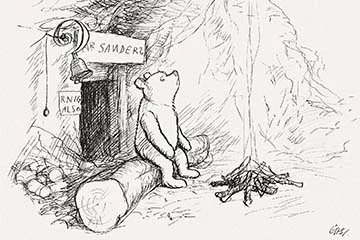
Pooh at 100
“Winnie-the-Pooh” first appeared a century ago.
On October 14, 1926, A.A. Milne’s “Winnie-the-Pooh” first appeared in the United States and Britain. A century later, the bear from the Hundred Acre Wood remains a fixture of children’s literature and popular culture.
Publishers are already marking the centennial with new editions and commemorative releases.
Pooh’s anniversary also provides an unusually broad cultural content opportunity for marketers. Booksellers and toy shops have a clear connection, but the story can also inspire content about childhood, friendship, nature, reading, and even honey.
Here are a few examples.
- A seller of used books could publish “5 Children’s Books Influenced by ‘Winnie-the-Pooh.’”
- An art and stationery store might explore how E.H. Shepard’s illustrations helped define the characters.
- An online collectibles shop could look at how Pooh evolved from a 1926 literary character into a global pop-culture icon.
- An outdoor or travel merchant could tell the story of Ashdown Forest, the real landscape that inspired the Hundred Acre Wood.
- An ecommerce toy shop could publish a nostalgic history of Pooh toys across generations.
- An online fashion boutique could examine why Pooh imagery has endured in clothing and popular culture.
Halloween UGC

Halloween gives consumers plenty to create and share.
For the spookiest of holidays, content marketers can combine retail selling with user-generated content.
Halloween is important for retailers, worth more than $13 billion in the United States. Several of those billions come from candy and costumes, but decorations, entertainment, and even the pet segment make up the rest.
Next is UGC. Generative AI makes polished content cheap and abundant. But AI doesn’t prove that real humans use and like a product.
UGC does.
Customer photographs, videos, reviews, and social posts can provide the sort of evidence synthetic content cannot.
Social platforms recognize the distinction, too. Pinterest labels AI-generated images and lets users reduce them in some categories. TikTok and Meta have taken similar steps to identify AI material.
For October, an online shop could ask customers to submit, for example, Halloween costumes, decorations, recipes, or pet photos featuring its products.
A kitchen merchant might collect photos of creepy cakes and cookies. An apparel seller could feature customer-created costumes. A pet supply shop could invite shoppers to submit pictures of costumed dogs, cats, and perhaps the occasional uncooperative rabbit.
The best submissions could become articles, social posts, email content, product-page galleries, or even a Halloween contest.
AI vs. Expert

Seasonal maintenance could provide AI-versus-expert content.
October is a month of seasonal change. Folks winterize homes, prepare vehicles for colder weather, store summer equipment, plan holiday meals, and pull coats and boots from the closet.
Those seasonal chores offer content opportunities.
Ask ChatGPT, Claude, Gemini, or another AI assistant how to accomplish a task related to the products your business sells. Then ask a human expert to review the recommendation, identify what the AI got right or wrong, and perhaps demonstrate a better approach.
Examples include:
- Online auto parts store: Ask AI for a winter car-preparation checklist, then have a mechanic grade it.
- Hardware store: Compare AI winterization advice with a contractor’s recommendations.
- Garden supply retailer: Have a horticulturist review an AI’s tips for protecting plants from frost.
Archives Month

Old catalogs, photographs, and product literature can become new content.
October is American Archives Month, an observance that raises awareness of the value of archives and the people who preserve them.
Retail businesses can participate by digging into their own histories.
Old catalogs, photographs, advertisements, packaging, newsletters, and even retired products can become source material for articles, videos, and social posts.
A longtime apparel retailer might show how styles have changed, while a gardening merchant could compare today’s equipment with what it sold 10 or 20 years ago.
An archive for new companies might contain industry products and developments. A kitchen supply shop could explore the evolution of cast iron skillets, for example.
News Hooks

Posts from celebrities such as Elon Musk are potential news hooks for content marketers.
A news hook can help content marketers attract, engage, and retain customers.
Here is an example.
In a conversation on X, Elon Musk wrote, “AI will be able to do anything digital (that doesn’t require shaping atoms) at a superhuman level by the end of next year.”
That hook led to an article on Science Fiction Classics, a site selling themed T-shirts. The article asserted science fiction writers had long ago predicted the future Musk was now describing.
Ecommerce content marketers cannot know which stories will break in October, but they can prepare to react. Monitor the news, companies, public figures, and cultural topics that interest a shop’s customers. When a strong connection appears, move quickly.

Musk’s post inspired an article about science fiction.


 Privacy Policy
 Refund Policy


